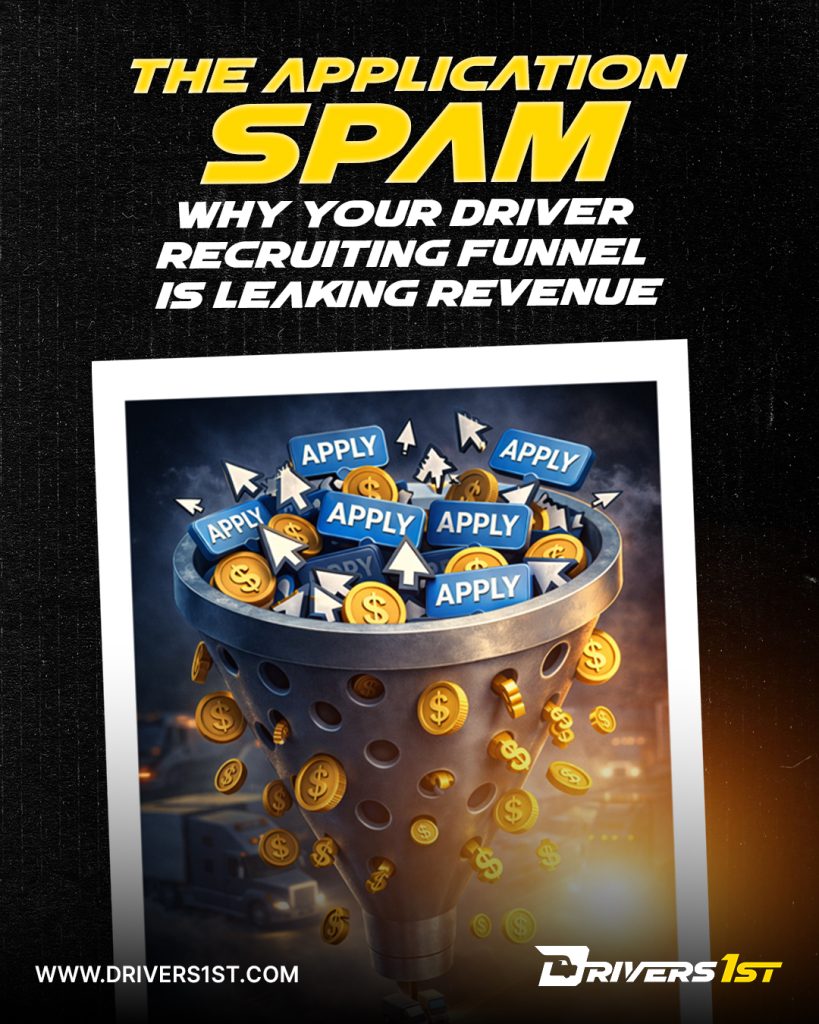
The Application Spam Tax: Why Your Driver Recruiting Funnel is Leaking Revenue
If you are a Fleet Owner or a Director of Recruiting for a fleet of 100+ trucks, you are likely looking at a dashboard that lies to you.
It shows a healthy volume of incoming applications. It shows that your “cost-per-lead” on Indeed or ZipRecruiter is holding steady. But when you walk into the recruiting office, the mood doesn’t match the data. Your recruiters are exhausted, your orientation classes are half-empty, and your cost-per-hire is quietly eroding your margins.
You are paying the Application Spam Tax.
In the race to simplify the driver experience, “one-click” apply buttons have created a monster. We’ve made it so easy to apply that we’ve stripped away all intent. The result is a high-volume, low-intent model that is structurally designed to drain your resources.
The Financial Drain of the “Volume-First” Model
Traditional job boards operate on a simple premise: more is better. They sell you on the size of their database and the speed of their lead delivery. But for a transportation executive, the “cost-per-lead” is a vanity metric. The only metric that matters is the Total Cost of Acquisition (TCA), and the volume-first model is driving that number into the ground.
1. The Recruiter Productivity Trap
When your team receives 500 applications from a job board, they aren’t receiving 500 candidates. They are receiving 500 digital lottery tickets.
- The Ghosting Phenomenon: Research indicates that in 2024, teams interviewed roughly 40% more candidates per hire than they did just three years prior. This is because “one-click” applicants often don’t even remember applying by the time a recruiter calls them.
- The Opportunity Cost of Dialing: If a recruiter spends 6 hours a day dialing ghost leads, that is 6 hours not spent building relationships with qualified, high-intent drivers. You aren’t just paying for the lead; you’re paying for the specialized labor required to realize the lead is worthless.
2. The Hidden Cost of Churn
Volume-first recruiting often leads to “panic hiring.” When the funnel is full of low-intent leads, recruiters feel pressured to push through anyone with a pulse to meet orientation quotas.
- Data shows that the cost of truck driver turnover averages $8,234 per driver, with some estimates for specialized fleets exceeding $20,000.
- Drivers who apply via a generic job board ad have no social tie to your company. They are “cold hires.” Without a pre-existing trust bridge, they are 50% more likely to leave within the first 90 days if a slightly better offer appears elsewhere.
The “Intent-First” Alternative: The Road Recruiter Network
At Drivers 1st, we’ve spent 18 years watching the “Big Tech Tax” grow. We realized that the most valuable asset in the industry isn’t a job board’s database—it’s the peer-to-peer network of the drivers themselves.
This is the foundation of the Road Recruiter Network. It is an intent-first model that shifts the focus from “How many clicks can we get?” to “How many trusted conversations can we start?”
1. Peer-to-Peer vs. Algorithm-to-Driver
A job board uses an algorithm to match a driver to a job. The Road Recruiter Network uses a driver to match a driver to a job. When a driver in our network refers a peer, they have already performed the “pre-qualification” that your recruiters usually have to do manually.
- Verified Intent: The applicant isn’t just clicking a button; they are acting on a recommendation from a colleague they trust.
- Higher Conversion: Referred candidates are hired nearly 4 times as often as candidates from other sources. A funnel that starts with intent doesn’t need to be massive to be effective.
2. Redirecting the “Big Tech Tax”
Every dollar you spend on “sponsored” posts for a generic job board is a dollar leaving the trucking ecosystem and entering the pockets of Silicon Valley. We believe in putting Drivers 1st. By using the Road Recruiter Network, you redirect that marketing spend. Instead of paying for “spam” volume, you are investing in a referral-driven infrastructure that rewards the people actually doing the work. This doesn’t just lower your cost-per-hire; it builds a culture where your drivers become your most effective recruiters.
Measuring the Impact: Efficiency & Retention
The transition from a volume-first to an intent-first model shows up in two critical areas of your P&L: Recruiting Overhead and Operational Stability.
| Metric | Volume-First (Job Boards) | Intent-First (Road Recruiter) |
| Lead Quality | Low-Intent / “One-Click” | High-Intent / Referred |
| Ghosting Rate | 60% – 80% | 10% – 20% |
| Recruiter Focus | Filtering & Sourcing | Closing & Onboarding |
| 90-Day Retention | Low (Cold Hire) | High (Social Connection) |
| Cost Structure | Variable / Scaling with Ads | Scalable / Performance-Based |
When your recruiters spend their day talking to people who actually want the job, burnout drops. When your orientation classes are filled with drivers who were referred by their peers, your 90-day retention climbs.
The Executive Mandate: Stop Buying Noise
As a fleet leader, you cannot afford to have your recruiting department act as a call center for low-intent leads. Every hour they spend chasing a ghost is an hour of “empty seat” revenue loss for your fleet.
The Road Recruiter Network isn’t just another lead source. It’s a strategic shift. We provide enterprise-level support that allows you to scale your hiring fast, without the fixed headcount risk or the overhead of traditional RPO contracts.
Stop paying the Application Spam Tax. It’s time to move toward a model where intent is the baseline, not the exception.
For more updates and insights into the trucking world, stay tuned to Drivers1st.com!