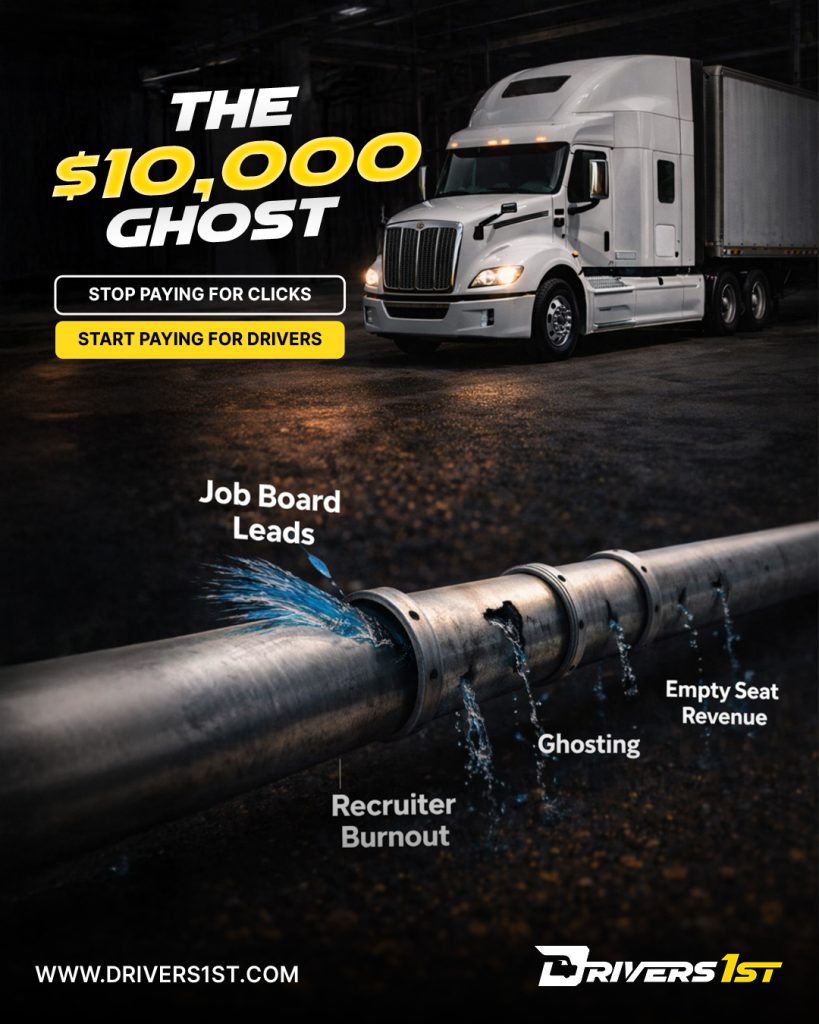
In the world of fleet operations, we obsess over “cost per mile.” We track fuel surcharges, tire wear, and insurance premiums down to the penny. But when it comes to the most expensive component of the business, the driver, many CEOs are surprisingly comfortable with a metric that is fundamentally broken: The Cost Per Lead.
If you are a CEO or President of a 100+ truck fleet, you’ve likely looked at a marketing report recently that boasted a low cost-per-lead (CPL) from platforms like Indeed, ZipRecruiter, or Meta. On paper, it looks like a win. In reality, that “cheap” lead is often the most expensive line item in your recruiting budget.
The “Job Board Model” has created a crisis of application spam. By prioritizing volume over intent, these platforms have forced your recruiting team into a reactive, high-friction cycle that erodes your margins and leaves seats empty.
The Anatomy of the “Job Board Tax”
The traditional recruitment funnel is built on the “One-Click Apply” philosophy. While this is great for the job board’s quarterly revenue, it is disastrous for a trucking company’s operations.
When it becomes too easy to apply, intent vanishes. You aren’t receiving applications from drivers who want to work for your fleet; you are receiving data points from people who are mass-applying to thirty companies while sitting at a red light.
1. The Recruiter Burnout Factor
Your recruiters are your high-value closers. Their job should be selling your company’s culture, benefits, and lanes to qualified professionals. Instead, the Job Board Model turns them into data-entry clerks.
When your team has to sift through 500 leads to find five viable candidates, they aren’t “recruiting”, they are mining for needles in a haystack. This leads to a specific type of operational rot: Recruiter Burnout. High-performing recruiters leave when they feel like they are spinning their wheels, and replacing a seasoned recruiter costs your company even more in lost momentum.
2. The Ghosting Epidemic
Low-intent leads lead to high ghosting rates. If a driver didn’t put effort into the application, they won’t put effort into the phone interview or the orientation. Every time a driver “ghosts” a scheduled interview, you lose the recruiter’s prep time and the operational slot reserved for that hire.
The Hidden Financial Leak: Empty Seat Revenue Loss
Most leadership teams measure the cost of recruiting based on ad spend. That is a mistake. The true cost includes Empty Seat Revenue Loss (ESRL).
Every day a truck sits idle because your recruiting team is busy calling “ghost” leads from a job board, you are losing between $800 and $1,200 in daily revenue. If your time-to-hire is 21 days because your team is bogged down by spam, but it could be 10 days with high-intent leads, that 11-day gap represents over $10,000 in lost revenue per truck.
Multiply that across 50 trucks, and the “cheap” job board leads are actually costing you half a million dollars in missed opportunities.
A Better Way: The Road Recruiter Peer-to-Peer Model
At Drivers 1st, we recognized that the best drivers aren’t looking for jobs on Google; they are talking to other drivers. We built the Road Recruiter Network to weaponize the most powerful force in the industry: Peer-to-Peer Trust.
Shifting from Quantity to Intent
Unlike the “Big Tech” model, the Road Recruiter Network doesn’t focus on clicks. We focus on referrals. When a driver is referred by a peer, the trust deficit is bridged before your recruiter even picks up the phone.
| Feature | Job Board Model | Road Recruiter Network |
| Lead Source | Algorithm-driven / Cold | Peer-driven / Warm |
| Initial Intent | Low (One-click spam) | High (Vetted by peer) |
| Recruiter Effort | High (90% filtering) | Low (Focus on closing) |
| Retention Rate | Low (90-day churn risk) | High (Built-in social tie) |
| Cost Basis | Fixed monthly / Per click | Performance-based |
Reducing the “Tech Tax”
By moving your spend away from Google and Meta and redirecting it toward the Road Recruiter Network, you are essentially taking money out of the pockets of Silicon Valley and putting it into the hands of the people who actually move the freight. This creates a virtuous cycle where drivers are incentivized to bring you high-quality talent, and your recruiters only spend time on conversations that have a high probability of conversion.
Conclusion: Operators Lead, They Don’t Just Spend
If your current recruiting strategy is “more spend equals more drivers,” you are at the mercy of an algorithm that doesn’t care about your retention rates or your recruiter’s sanity.
The most successful fleets in 2026 are those that have realized recruiting is a sales and marketing function, not an administrative one. By eliminating application spam and focusing on high-intent, peer-to-peer referrals, you reduce your overhead, eliminate recruiter burnout, and, most importantly, keep your trucks moving.
Stop paying for clicks. Start paying for drivers who actually show up.
About Doug Drier & Drivers 1st
With 18 years of transportation experience, Doug Drier and the Drivers 1st team provide RPO-level results without the rigid, long-term contracts. Through the Road Recruiter Network, we help fleets scale fast by leveraging peer-to-peer recruitment and cutting-edge operational efficiency.
Ready to audit your recruiting spend?
Book a 15-minute Strategy Call with Doug Drier
For more updates and insights into the trucking world, stay tuned to Drivers1st.com!
Download our App