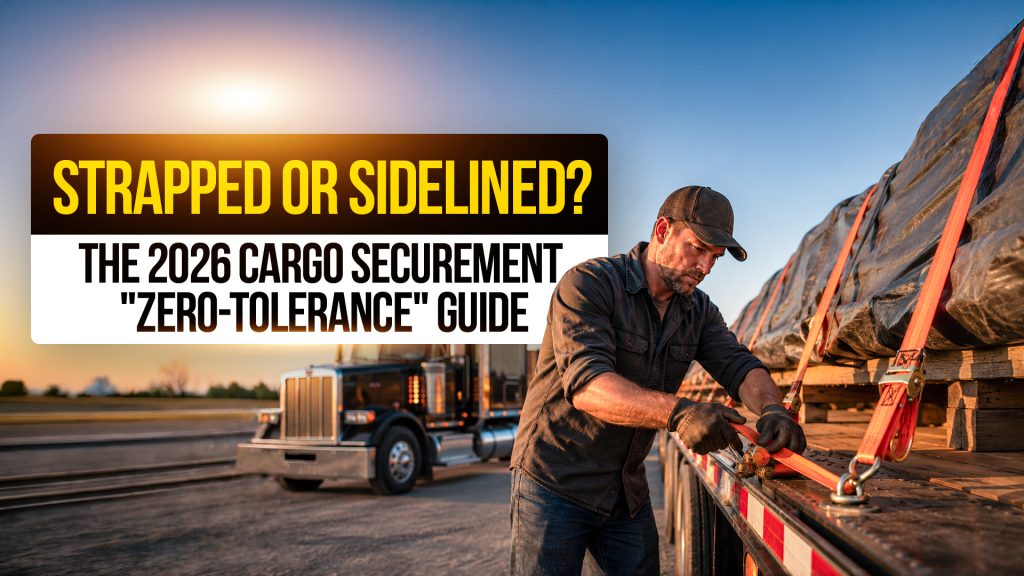
The road is getting tighter in 2026, and not just in the lanes. The FMCSA has signaled a shift toward “zero-tolerance” for cargo securement during roadside inspections.
With Roadcheck 2026 officially naming cargo securement as the primary vehicle focus area, a single frayed strap isn’t just a warning anymore it’s a one-way ticket to an Out-of-Service (OOS) order.
For a Class A driver, an OOS order is a profit-killer. When you’re sidelined, you’re losing an average of $1,000 in revenue per day, not counting the hit to your safety record or potential hikes in insurance premiums. Your truck driver pay depends on keeping those wheels turning, and that starts with a “no-BS” approach to your pre-trip.
The New Standards: What’s Changing in 2026?
The FMCSA’s updated enforcement data shows that in 2025 alone, inspectors recorded over 18,000 violations related to cargo leaking, spilling, or falling. Because of this, 2026 is the year of the “hard-line” inspection.
Inspectors are specifically hunting for three major “points of failure”:
- Tie-down Integrity: Any sign of wear, cutting, or structural deformation on synthetic webbing is an immediate red flag.
- Friction & Protection: Edge protection is no longer a suggestion; it is mandatory whenever a tie-down is subject to abrasion or cutting.
- Inboard Placement: On trailers with rub rails, all tie-downs must be located inboard of those rails whenever practicable to prevent damage from external strikes.
With flatbed load-to-truck ratios hitting a staggering 124% increase year-over-year in early 2026, the pressure to move fast is high. However, “fast” shouldn’t mean “loose.” Trucking companies near me are increasingly auditing their own fleets because they know the trucker salary and company reputation are on the line during every Level I inspection.
Pro Tips for the Professional Class A Truck Driver
- Know Your Ratings: Even if a tie-down is unmarked, the FMCSA treats it as having the lowest possible Working Load Limit (WLL). For example, unmarked welded steel chain is treated as Grade 30 proof coil. Don’t guess know what your gear can handle.
- Immobilize or Bust: Cargo must be firmly immobilized using dunnage, shoring bars, or tie-downs to prevent any shifting. If it rolls, it needs chocks or wedges that can’t vibrate loose during transit.
- Document Your Checks: In 2026, showing a consistent “culture of safety” is your best defense. Use your Driver Account to keep your credentials updated so you’re always ready for the next level of your career.
If your current carrier is pushing you to run with sub-par equipment or ignoring your maintenance requests, it might be time to browse vetted truck driver jobs. Check out the Drivers 1st Job Board to find companies that respect the professional standards of a Class A truck driver.
Road Recruiter Spotlight: Help Your Crew Get Paid
You know who the best drivers are on the road the ones who actually check their straps and know their HOS. Why not get paid for knowing them?
Through the Road Recruiter program, you can earn $1,000+ for every Class A driver you refer who gets hired. It’s a “drivers helping drivers” side hustle that keeps the trash off the road and more money in your pocket.
Conclusion
The 2026 enforcement landscape doesn’t leave much room for “good enough.” Whether you’re looking for local CDL jobs or long-haul routes, your ability to secure a load is what keeps your business and your life on the rails.
Your license is your business make it work for you.
For more updates and insights into the trucking world, stay tuned to Drivers1st.com!
Download our App